Q&A: The Difference Between a Doula & a Midwife; When to Head to the Hospital During Labor; What’s a VBAC

In this episode of the Breath and Birth Co. podcast, Vanessa, a DONA-certified birth doula and childbirth educator, answers common questions about care provider roles and procedures. She distinguishes between the non-medical support of doulas and the medical care provided by midwives and obstetricians, explaining various midwife credentials. Vanessa also discusses when to head to the hospital during labor, what VBAC (vaginal birth after cesarean) entails, and stresses the importance of informed decisions and finding the right provider. This episode offers valuable insights, practical tips, and resources for expecting parents.
Q1: What’s the difference between a Midwife and a Doula?
When it comes to pregnancy and childbirth, the roles of a doula and a midwife are often misunderstood or conflated. While both provide valuable support to pregnant individuals, their roles and responsibilities differ significantly.
Doulas are:
non-medical professionals who offer physical, emotional, and informational support to individuals before, during, and after childbirth
They focus on the holistic well-being of the birthing person, providing comfort measures, advocacy, and continuous support during labor.
Doulas do not perform any medical procedures or offer clinical assessments. They cannot offer medical advice, but can help you with the questions to ask your provider in order to make an informed decision.
On the other hand, Midwives are:
trained healthcare providers who offer medical care to pregnant individuals.
are qualified to conduct physical exams, provide prenatal care, assist during labor and delivery, and offer postpartum care to both the birthing person and the newborn.
Midwives can also prescribe medications, order medical tests, and diagnose and manage complications during pregnancy and childbirth.
Ultimately, the key difference lies in the scope of practice:
doulas offer non-medical support,
while midwives are trained healthcare professionals responsible for the clinical management of pregnancy and childbirth.
It is also important to understand there are multiple designations for midwives, and each title clarifies their education and background experience in perinatal care.

Traditional Midwife: These are midwives who choose not to become certified or licensed. They believe that they are ultimately accountable to the communities they serve; and that midwifery is a social contract between the midwife and client/patient, and should not be legislated at all; or that women have a right to choose qualified care providers regardless of their legal status.
Certified Midwife (CM): Certified Midwives are individuals who have or receive a background in a health related field other than nursing, then graduate from a masters level midwifery education program. They have similar training to CNMs, conform to the same standards as CNMs, but are not required to have the RN.
Certified Nurse Midwife (CNM): Certified Nurse-Midwives are trained in both nursing (RN) and midwifery. Their training is hospital-based, and the vast majority of CNMs practice in clinics and hospitals. Although their training occurs in medical settings, the scope of practice allows them to provide care in any birth setting.
Certified Professional Midwife (CPM): The CPM is the only midwifery credential that requires knowledge about (and experience in) out-of-hospital settings. Their education and clinical training focuses on providing midwifery model care in homes and freestanding birth centers. In some states, CPMs may also practice in clinics and doctors offices providing well-woman and maternity care.
Obstetrician (OB-GYN): And while an Obstetrician is not a Midwife, it’s important to also understand the difference between an OB-GYN and a Midwife. An Obstetrician is a physician that provides medical care related to pregnancy and childbirth. They treat medical conditions unique to pregnancy and perform surgeries related to labor and delivery. It is important to note that one can be a Gynecologist without being an Obstetrician, but an OB must also be a GYN.
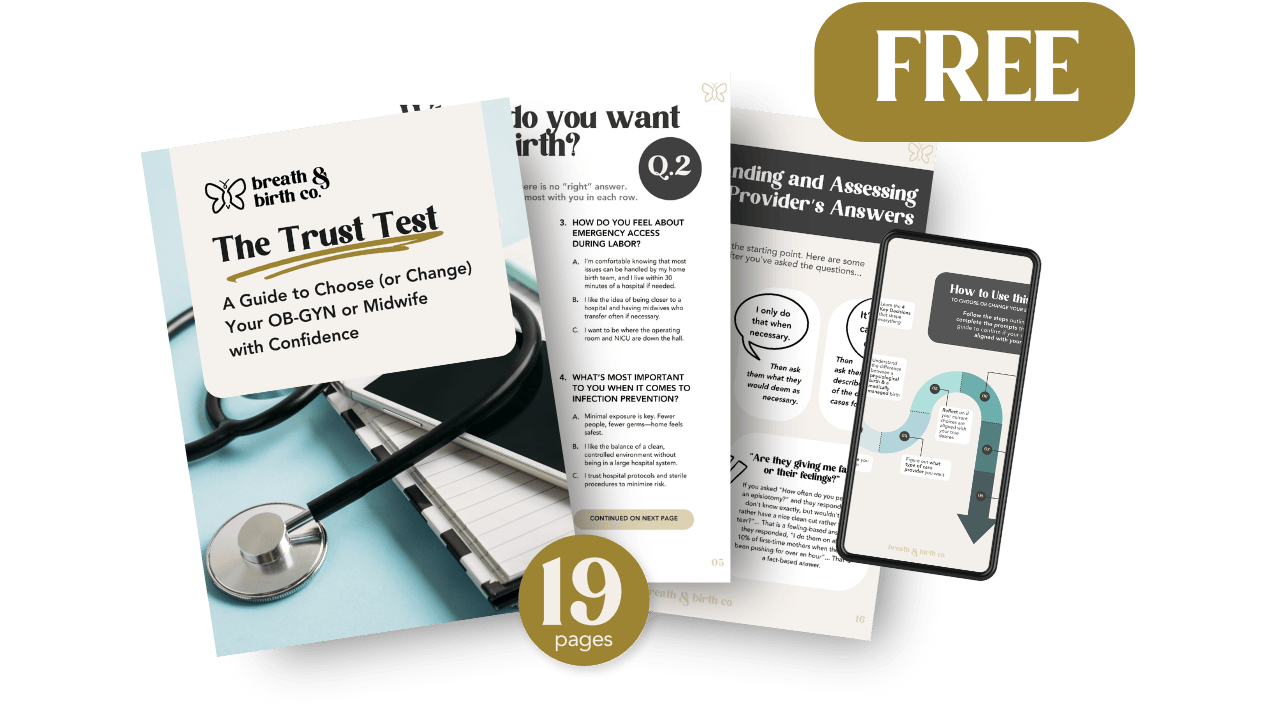
Now that you understand the different roles and qualifications between a Doula, Midwives, and Obstetricians, if you’re interested in diving deeper into which may be the best fit for the birth you envision, I’ve got a FREE guide that covers it all and will get you feeling confident in your decision.
Q2: When should I head into the hospital during labor?
The answer? It depends.
There are a few key factors that influence your best timing—and no, it’s not one-size-fits-all. So let’s walk through how to make this call with calm, confidence, and connection to your body and your birth plan.
1. First, consider: How far are you from your birth location?
If you live an hour or more from your hospital or birth center, it’s often a good idea to err on the side of caution once labor picks up.
Some ideas to stay nearby without committing to check-in just yet:
• Scope out local parks or walking trails near your hospital where you can continue laboring
• Consider booking a hotel room close by, especially if you’re in early labor or live in a rural area
2. Next, think about which number baby this is.
For first-time labors, things typically progress more gradually. For second (or third, or fourth…) labors? They tend to move much more quickly once active labor kicks in. That means:
If this isn’t your first baby, you’ll want to give yourself a shorter window between recognizing active labor and making your move.
When in doubt, trust your body’s cues—and if things feel like they’re escalating fast, go.
The 5-1-1 (or 3-1-1) Rule

This general guideline is a helpful place to start.
You’re likely in active labor if your contractions are:
• 5 minutes apart (or 3 minutes for faster labors)
• Lasting 1 full minute
• Continuing for 1 hour or more
Still, always check in with your provider to see which benchmark they recommend for your specific birth plan.
What does active labor look and feel like?

Here are some physical and emotional signs you might be moving into active labor:
• Regular, intense contractions that increase in strength and frequency
• True labor vs. false labor: True contractions do not ease up with rest, hydration, or changing positions
• You can’t talk or walk through contractions anymore
• You’re turning inward—often eyes closed, focused
• Instinctual movement: You might find yourself rocking, swaying, or moaning
• Cervical dilation confirmed by a provider—usually around 5–6cm marks the start of active labor
What if my water breaks?
Despite what the movies show, water breaking doesn’t always mean a dramatic gush. More often, it’s a steady trickle of amniotic fluid.
Keep these tips in mind:
Note the smell and color. Clear and odorless = usually a good sign
Call your provider to check in—they may want to assess you or offer advice on next steps
Unless you’re experiencing other signs that need immediate attention, it’s often okay to continue laboring at home for a bit longer
When to head in right away:
If you experience any of the following, skip the timing apps and go to your hospital or call your provider immediately:
• Heavy bleeding (like a period)—this is a medical emergency
• Decreased fetal movement
• Intense or sharp pain that doesn’t ease with position changes or rest
• You’ve been advised to come in sooner due to:
• High-risk pregnancy
• Signs of preterm labor
• Any medical conditions that require closer monitoring
Q3: What is a VBAC?
There are a few different designations to talk through here: VBAC, TOLAC, HBAC, CBAC
VBAC: vaginal birth after cesarean
TOLAC: trial of labor after cesarean
HBAC: home birth after cesarean
CBAC: cesarean birth after cesarean
This question is important because I feel like so many people think once they have a cesarean that is their only option for all future births. That’s not always the case, and you deserve to understand ALL of your options and the risks and benefits of each option.
If this is something you are interested in exploring, aside from working through any past traumas and biases you may have with your previous cesarean birth or births, the most impactful decision you can make in achieving a VBAC is finding a VBAC-friendly provider. I’ve got a few open-ended questions specific to VBACs in my free guide.
I also highly recommend the following resources:
VBAC Link: The VBAC Link podcast | The VBAC Link website | VBAC Link Instagram
has a ton of resources and also offer trainings for both birthers and doulas
their website also has a map where you can search for local VBAC Certified Doulas
If you’ve got questions…
If you’re pregnant for the first time and/or asking yourself any of these questions, I highly recommend seeking out a childbirth education course. While your local hospital probably offers courses, I’m going to be honest: they tend to teach you how to be a good patient. Those hosted outside of the hospital setting tend to be much more comprehensive, and hopefully you’ll be able to find a specific method or teacher that you truly resonate with.
I offer an online self-paced course called Metamorphosis, so I’ll plug that one now. Metamorphosis is a transformational, self-paced, comprehensive online childbirth education course. It’s almost 8 hours of video content spread across 50 lessons in 4 modules, and over 200 pages of guides and worksheets. And affirmations at every step.

In the foundation module, you’ll determine your “why”, learn what a physiological birth looks and feels like, and how baby’s station can mean more than your cervical dilation.
In the connection module, you’ll ensure your care provider is aligned with the birth you envision, and how to build out your village in a way that sets you up for best success all the way through postpartum.
Then there’s the confidence module, where you’ll learn ALL of your options and be equipped with evidence-based resources to make an informed decision each step of the way, culminating in your very own birth plan.
And last, but certainly not least, in the calm module you’ll release fears that are holding you back from the birth you envision, infuse peaceful meditations into your daily routine, and practice proven pain-coping methods to prepare you for labor.
Knowledge is power, and I’m so grateful you’re here listening to this episode. If you’re interested in childbirth education but self-paced online learning is not your cup of tea… or you may be looking for another specific method… there’s no gatekeeping here! In that case, I have a referrals page on my site for various other Columbus, OH local childbirth education and live online childbirth education options in case any of those would be a better fit for you. Again, I just want to encourage and empower you to have the information you need to advocate for the birth YOU desire.
Subscribe, Share & Review:

💛 If you loved this episode, don’t forget to subscribe to The Breath & Birth Podcast so you never miss a moment of calm, connection, and confidence on your pregnancy journey.
📲 Share this episode with a friend who needs to hear this so they don’t feel so alone.
⭐️ And if you have a moment, leave a quick rating or review on Apple Podcasts —it helps more families find their way to empowered birth.
-
General Childbirth Education:
Q1: What’s the difference between a Doula and a Midwife?
Q3: What is a VBAC?
-
00:00 Welcome to the Breath and Birth Co. Podcast
00:47 Introduction to Q&A Format
01:06 Understanding the Roles: Doula vs. Midwife
03:46 Different Types of Midwives
05:31 Obstetricians vs. Midwives
06:34 Guide to Choosing Your Birth Support
08:26 When to Head to the Hospital During Labor
15:21 What is a VBAC?
18:05 Childbirth Education and Resources
20:18 Closing Remarks and Encouragement
-
Vanessa: Welcome to the Breath and Birth Co. podcast. I'm Vanessa, a hospital based, DONA- International certified birth doula, and passionate childbirth educator. I love to merge the power of your intuition with the precision of modern medicine to help you navigate pregnancy and birth your way. Each week we kick off with Monday meditations to bring calm and connection to your pregnancy.
Then we build your confidence through insights, birth stories, and care provider perspectives during thoughtful Thursdays. Ready to feel supported, informed, and empowered? Hit subscribe to the Breath and Birth Co. podcast today and let's embark on this transformational journey together. As a reminder, any information shared here is not medical advice.
For more details, visit breathandbirthco. com slash disclaimer.
Okay, welcome to our first question and answer episode. I'll be alternating solo episodes between the Q& A format, and sharing some of my journey, like I did in episode one, on how I got to birthwork in my own story, and things that I'm learning through my continuing education
so the first question I have is, what's the difference between a doula and a midwife?
And oh my, if I had a dollar for every time somebody asked me or told me, oh, so you get to deliver babies or you get to catch babies, , as a doula, that is not the case. So, I think this is a great question to start with. So when it comes to pregnancy and childbirth, the roles of a doula and a midwife are often misunderstood.
While both provide valuable support to pregnant individuals, their roles and responsibilities do differ significantly. I'll start with doulas, since I am a certified doula through Dona International. And we are non medical professionals who offer physical, emotional, informational support to individuals before, during, and after childbirth.
, we focus on holistic well being of the birthing person, providing comfort measures, advocacy, and continuous support during labor. So that can look like, , telling you which positions might be good, depending on where baby is in a pelvis, giving you affirmations, prompting you to ask questions, or reminding you of the questions that you have when discussing with either the nurse or your care provider.
But doulas do not perform any medical procedures or offer clinical assessments. So we cannot offer any medical advice, but again, we can help you with the questions to ask your provider in order to make an informed decision. And we are there to support whatever decisions you make or whatever, your birth preferences look like.
We're there to support that wholly.
Midwives are trained healthcare providers who offer medical care to pregnant individuals. So they are qualified to conduct physical exams, provide prenatal care, assist during labor and delivery, and offer postpartum care to both the birthing person and the newborn.
Midwives can also prescribe medications, um, order medical tests, and diagnose and manage complications during pregnancy and childbirth.
Ultimately, the key difference between a doula and a midwife is the scope of practice. So doulas offer non medical support, while midwives are trained healthcare professionals responsible for the clinical management of pregnancy and childbirth.
It's also important to understand that there are multiple different designations for midwives and each title clarifies their education and background experience. , and so you might want to understand these different designations as well. First, we have the traditional midwife. So these are midwives who choose not to become certified or licensed.
They believe that they're ultimately accountable to the communities that they serve and that midwifery is a social contract between the midwife and the client or patient. And They believe that it should not be legislated at all, that women have a right to choose qualified care regardless of their legal status.
And then we have a certified midwife, or CM for short. Certified midwives are individuals who have or receive a background in a health related field other than nursing, then graduate from a master's level midwifery education program. They have similar training to CNMs, which I'll talk about next, and they conform to the same standards as CNMs, but are not required to have an RN.
And, Certified Nurse Midwife, or CNM for short, they are trained in both nursing as an RN and midwifery. Their training is hospital based and the vast majority of CNMs practice in clinics and hospitals. , although their training occurs in medical settings, the scope of practice allows them to provide care in any birth settings.
Um, so birth center, home birth, et cetera.
And then we have a certified professional midwife, or CPM, only midwifery credential that requires knowledge about and experience in out of hospital settings. So their education and clinical training focuses on providing midwifery model care in homes and freestanding birth centers.
In some states, CPMs may also practice in clinics and doctor's offices providing, uh, well women in maternity care. And then this conversation wouldn't be complete without also mentioning obstetricians. So we've got doulas who are non medically trained, midwives who are medically trained, and then obstetricians, which is not a midwife, obviously, um, but it's important to understand the difference between an OBGYN and a midwife.
So an obstetrician is a physician that provides medical care related to pregnancy and childbirth. We probably know that already. And they treat medical conditions unique to pregnancy and perform surgeries related to labor and delivery. And it's important to note that, , one can be a gynecologist without being an obstetrician.
So you can have a GYN that you see, for instance, for your annual exams or just your, female care. That, and they don't attend birth or have pregnant, , patients or . They don't focus in, uh, in the obstetrics field. But an OB must also be a GYN, so an obstetrician has to be a gynecologist focused in obstetrics.
So now that you understand, , the different roles and qualifications between a doula, midwives, and obstetricians, if you're interested in diving deeper into which may be the best fit for you for the birth that you envision, I've got a free guide that covers it all and will get you feeling confident in your decision.
, I'll link that in the show notes and it goes over the different credentials. You can have that in writing, so you can refer back to it, and then it, , prompts you with some questions to ask and really see what type of birth you envision in terms of environment and your preferences, and then it also has a list of interview questions, whether you are, um, interviewing a hospital based provider or a birth center, et cetera, They're focused questions for those and they are open ended questions because we don't want to Prompt the provider in giving you the answer that you want to hear.
We want to hear Their true philosophy in any statistics that they have to share with you and then from there The guide also provides, , how to analyze their answers and how to dig deeper and ask further questions and any red flags in the way the provider is answering your questions or treating you, either in their tone of voice or demeanor as you're asking these questions. Um, so, so you're aware of those red flags to pay attention to. And then ultimately, if you find yourself in a situation where your current provider or a provider you're interviewing just isn't the right fit, I go over simple steps in how to either step away and essentially fire the provider and find a new one.
Or just simply part ways and find a new one that does align with your preferences. So again, that's a 16 page guide, free, um, available on our website. I'll link it in the show notes for you there.
Okay, and that brings us to question number two of the day. When should I head to the hospital during labor?
So this is a kind of a complicated question, but simply put, it can vary depending on how far you live from the hospital and what number baby this is for you. Obviously, if you live, for instance, an hour or more drive, if your hospital is really far, you might It might be best to err on the side of caution and head out to be within the vicinity of the hospital at least a little bit sooner.
This can look like scoping out local parks or walking trails where you can, again, be in the vicinity of the hospital, but you might not necessarily want to go in and be admitted quite yet.
If this is not your first labor, subsequent labors tend to go much quicker, not always, but usually. And so in that case, I'd also err on the side of caution once you hit active labor because things can escalate quickly if it's your second, third, fourth birth. Generally speaking, there is a 5 1 1 rule.
Some say 3 1 1, so I'm interested in what your providers are telling you. Um, so I would recommend asking your provider , and then again, taking into consideration your individual situation. Um, and a 5 1 1 rule, means contractions are five minutes apart. They're lasting one minute each and they continue for one hour or more consistently in that pattern.
And this typically is a good sign that you're in active labor at that point. And so what does active labor look like? Regular contractions, as I just mentioned. So true labor contractions occur at regular intervals and they'll grow closer together and become more intense over time. True contractions don't stop with rest or hydration.
They'll continue that pattern and again, get more intense, more frequent. You're not going to be able to talk or walk through contractions during true active labor. Um, if you're laughing or giggling, telling stories, sleeping. , you're not in active labor. This is probably , early labor, which is great, and we'll want to rest, and we want to, , nest , and do things to distract you during that time, but once you cannot talk or walk through contractions, It's a good sign that you're approaching or in active labor.
Typically, the birther will also turn inward, often keeping your eyes closed both in between and during contractions, and really focusing inward again, like really only answering questions in like one word or, you know, waving your hands not really paying attention to what's happening around you, but really working in understanding Getting through each wave or contraction and then that rest in between and that inward focus. Uh, oftentimes you'll find yourself moving instinctually in your body, so this can look like rocking or swaying.
Um, moaning is very, very common during contractions, like the guttural, , almost animalistic primal sounds. As they get more intense, um, this can happen, . very intensely during transition, which is the latter part of active labor. And then ultimately, , cervical changes can also help you determine. So this, you'll only know if a provider checks your cervix.
Um, but typically around five to six centimeters is the mark for active labor. Again, with all of these other symptoms or physiological things happening with your body. Cervical checks are optional. You should consent to a cervical check if you want one. But you don't have to. And so that's why I'm sharing some of these other ways to, Understand if you may be in or approaching active labor, but sometimes it's helpful to have that number in your mind.
So if you go in and you happen to be checked, let's say, at a prenatal appointment at like 39 weeks or something and you're one centimeter, that really is not going to tell you very much because labor is not linear. But again, you can have a frame of reference of, okay, I've got, you know, X amount of centimeters to go from there.
Um, another point that I'd like to make is that When your water breaks, it can happen at any time during labor, so it's not necessarily a good indicator of how far along you are. Just because your water breaks does not necessarily mean that you're in active labor. Typically, it does happen later in labor, but it can happen.
, happen before you're really dilated or effaced, , very much. And that can be a gauche, which is, what you see in the movies and shows and everything. But it's actually much more common to have a steady trickle of amniotic fluid you might feel or hear at the pop. Um, but it's not this, like, Wave and spraying all over necessarily every time.
So if you suspect your water has broken, take note of the smell and the color. And it's a good idea to call your provider and let them know and ask any questions that you may have so that they can properly assess and you can make an informed decision about whether or not to continue laboring at home or heading into the hospital.
If there's no smell and it's clear, those are good signs that you can continue laboring at home, but again, consult with your provider and make an informed decision. , heavy bleeding, like a period, maybe a medical emergency, so you should definitely head to the hospital or call your provider to confirm.
Decreased fetal movement is another reason why you'd want to head to the hospital and make sure that things are okay. Intense pain, if you're experiencing any severe pain that's not relieved by position changes or rest, , call your provider. Sometimes this can be back labor if your baby's in the OP or sunny side up position, and some positions may be able to help with that.
Spin the baby around and relieve that pain, um, but ultimately if you're not coping well and you feel your intuition is telling you that something's wrong, definitely give your provider a call and then, , obviously any other complications, uh, if you're advised to come in sooner due to a high risk pregnancy, preterm labor signs or other medical concerns, follow your care plan, , So to summarize, unless you have other complications or your water's broken and there are signs that there could be an infection or meconium in the waters, probably good to follow the 5 1 1 or the 3 1 1 rules.
So, five minutes apart, lasting one minute each, and that continues consistently for one hour or more.
Okay, and the third question is, what is a VBAC? So, A VBAC is, that's an acronym that stands for Vaginal Birth After Cesarean, and in talking about VBACs, I'd also like you to understand, , several other acronyms that you might hear in reference or in,, periphery of a VBAC. Um, that's TOLAC, which is Trial of Labor After Cesarean.
Sometimes people use this acronym or term. For somebody that's attempting a VBAC and they use the VBAC for once a VBAC is actually accomplished. So a vaginal birth after cesarian has already occurred, they call that a vbac. Whereas if, for instance, during pregnancy or you're discussing your birth plan and preferences, some people prefer to reference that as a tolac or a trial of labor after cesarean.
, you may hear either of those and just use what you're comfortable with. Um, an HBAC, so H B A C, that's a home birth after cesarean, and then a CBAC is a cesarean birth after cesarean. So this question is important because I feel like so many people think once they have a cesarean that that's their only option for future births.
And that's not always the case. In fact, most of the time you do have options and you deserve to understand all of those options and the risks and benefits associated with each of them. So if this is something you're interested in exploring, aside from working through any past traumas or biases that you might have from your previous cesarean birth or births, the most impactful decision that you can make in achieving a VBAC is finding a VBAC friendly provider.
So, VBACs, for whatever reason are highly controversial, it's associated with the liability around the potential for uterine rupture, though very, very slim. And it's your right,
I also highly recommend listening to the VBAC links podcast and following them on social media.
They're true experts in all things VBAC. They have a ton of resources and offer great trainings for both birthers and doula. So if you're a doula listening and want to become an advanced VBAC certified doula, they have that available for you as well. And their website actually has a map so that if you're a birther, you can search your local zip code and see if there's any, , certified VBAC doulas through their program local to you.
, and I'll, again, I'll link all of this in the show notes as well.
So that's a very high level summary of what a VBAC stands for and just a little plug that if you had, , one or more previous cesarean births that it's very likely that you could have a vaginal birth, , if that is what you desire. It's just important that you understand , the risks , and know your options.
If you're pregnant for the first time and or asking yourself any of these questions, I highly recommend seeking out a childbirth education course. While your local hospital probably offers courses, I'm going to be honest, they tend to teach you how to be a good patient. Those hosted outside of the hospital setting tend to be much more comprehensive And hopefully you'll be able to find a specific method or teacher that you truly resonate with.
I offer an online self paced course called Metamorphosis, so I'll plug that one now. Metamorphosis is a transformational, self paced, comprehensive online childbirth education course. It's almost 8 hours of video content spread across 50 lessons. in four modules and comes with over 200 pages of guides and worksheets and affirmations at every step.
In the foundation module, you'll determine your why and learn what a physiological birth looks and feels like and how baby station can mean more than your cervical dilation.
In the Connection module, you'll ensure your care provider is aligned with the birth you envision, and how to build out your village in a way that sets you up for best success all the way through postpartum.
Then, there's the Confidence module, where you'll learn all of your options and be equipped with evidence based resources to make an informed decision each step of the way, culminating in your very own birth priorities plan.
And last, but certainly not least, in the calm module, you'll release fears that are holding you back from the birth you envision and infuse peaceful meditations into your daily routine. Then practice proven pain coping methods to prepare you for labor.
Knowledge is power, and I'm so grateful that you're here listening to this episode. And if you're interested in childbirth education, but self paced online learning is not your cup of tea, or you may have a specific method that you're looking for, there's no gatekeeping here.
In that case, I have a referrals page on my site I'll link in the show notes for various other Columbus, Ohio, local and live online options in case any of those would be a better fit for you. Again, I just want to encourage and empower you to have the information you need to advocate for the birth you desire.
Thank you so much for spending time with me today. I hope you found this episode helpful and encouraging on your journey. Don't forget to hit subscribe so you never miss a future episode. And if you enjoyed today's conversation, I'd be so grateful if you left a quick review. It helps others find the show.
For more information, visit Resources and links mentioned in this episode. Be sure to check out the show notes. You can also connect with me on Instagram at breathandbirth. co for more support and inspiration until next time, remember you've got this and you're never alone in this journey.